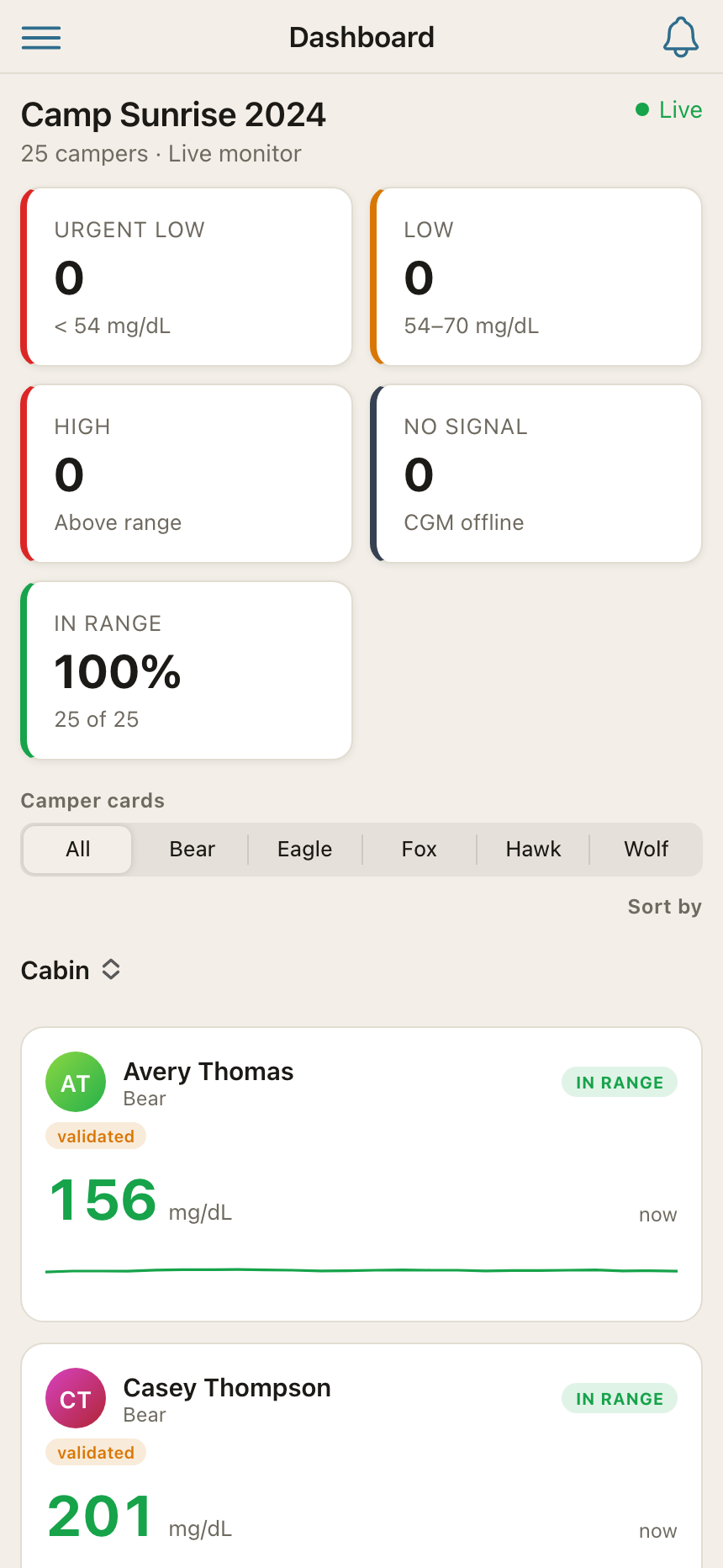
Dashboard — the whole camp at a glance
Five counts answer the only question that matters first: is anyone in trouble right now? Below, a card per camper shows name, cabin, the current number in mg/dL, how long ago it arrived, and a sparkline. Filter to one cabin, or sort by who is furthest out of range; tap a camper for a 0–300 gauge marked with their own thresholds and a two-hour trend.
| Urgent Low | Under 54 mg/dL |
|---|
| Low | 54–70 mg/dL |
|---|
| High | Above the camper's own threshold |
|---|
| No Signal | A CGM gone quiet — a reading older than 15 minutes stops counting as current |
|---|
| In Range | The share of campers currently in band, and the raw count behind it |
|---|
Alerts that need a human
Urgent, active and snoozed alerts stay up until someone answers. Acknowledging requires a note — "gave 15g fast carbs, recheck in 15" — and snooze is capped at five minutes so nothing gets silenced for the afternoon.
Counselors join through the cloud
Each counselor's phone is paired through the cloud to one cabin. Glucose readings are collected there and show up in the app. Remove them from the cabin and their access is gone.
Works when the network doesn't
Counselor devices keep a durable outbox. Acknowledgements and snoozes queue up, the camper card shows "Queued — will sync", and everything drains when the connection returns.
Sensors it talks to
Dexcom Share (US, outside US, and Japan regions) with credentials validated before the password is stored, plus a single LibreLinkUp follower account the whole camp shares.
Onboarding, tracked
Campers move through Pending, Invited, Credentials Received, Validated and Failed. If two campers share a name, the middle initial becomes required.
An audit log you can export
Every acknowledgement, snooze and admin action is written down with actor and timestamp, and exports to CSV or Markdown for the post-session report.